“One of the most wonderful surprises is that the most beautiful and interesting insights often come from bugs in the code.”
— Dmitri Cherniak, Bankless Metaversal, February 2021
Ringers minted out in 18 minutes, and there were 1,000 of them. At the time, I decided not to mint any Ringers myself even though I really wanted to, because I wanted people to have the chance to engage with generative art.
— Right Click Save, interview with Jason Bailey, April 2023

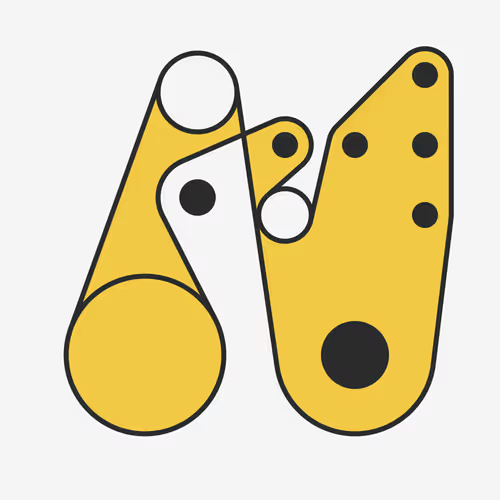
There are an almost infinite number of ways to wrap a string around a set of pegs. On the surface it may seem like a simple concept but prepare to be surprised and delighted at the variety of combinations the algorithm can produce. Each output from 'Ringers' is derived from a unique transaction hash and generated in Javascript in the browser. Feature variations include peg count, sizing, layout, wrap orientation, and a few colorful flourishes for good measure.
Project description, Art Blocks
Don't fight it. Just respect it. Made by Dmitri Cherniak with Javascript and GLSL.
Project description, Art Blocks
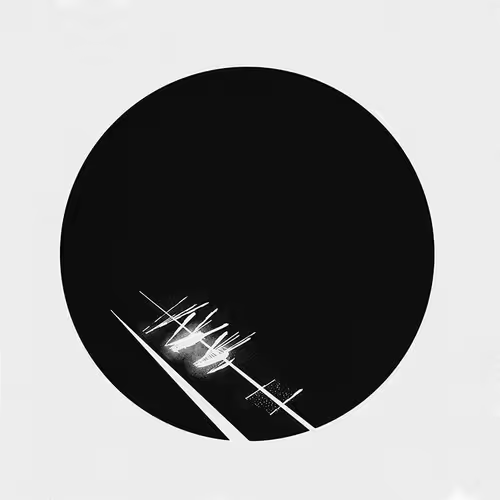
Light Years is a project from generative artist Dmitri Cherniak in partnership with The Estate of László Moholy-Nagy. It is an homage to the photogram as a medium, but with a digitally native twist.
Collection description, OpenSea
The Wrapture is a generative edition with unique properties. Technically it is capped at 666 editions, however holders of The Eternal Pump have the opportunity to limit the edition to 50 algorithmic editions if they can cooperate.
Project description, Art Blocks
As part of the Light Years project, the artist has released 30 process works/sketches for collectors to help visualize the evolution of the algorithm and outputs.
Collection description, OpenSeaA string around a set of pegs. A thousand times. He kept none of them for himself. Ringers #879 — The Goose — is the most discussed single output the category has produced, and that a collection of a thousand can turn on one of them is the argument for looking at generative work with the eye rather than the trait table.
One of the most wonderful surprises is that the most beautiful and interesting insights often come from bugs in the code. Compared to coding in solidity and smart contracts, where a small bug can create financial ruin, a bug in generative art can create unexpected levels of beauty. So throughout the process I have observed those bugs and turned them into features of the art.
Bankless Metaversal, Q&A with William M. Peaster, 24 February 2021I like to say that “automation” is my artistic medium and this project let me realize my artistic vision from start to finish; from sale via smart contract, to art generation using a unique transaction hash, Javascript stored on chain running in the browser, to delivery of goods using tokens sent to wallets. My “art” was about making sure someone could get an interesting and unique piece of work without any human interaction.
Bankless Metaversal, Q&A with William M. Peaster, 24 February 2021Every figure above comes from Alfred’s own dataset — sales, volume and owners read off the chain, floors from the marketplaces. On a wallet he goes one step further, to the number that gets buried under a decade of transfers: what you actually paid.
In the wallets we look at, nearly half of what people hold has no purchase price to look up. It arrived as a mint, a swap or a transfer.
Alfred follows each one back through the chain.
Both figures come from one reading: 16 wallets, 3,548 items, Sep 2026.
See what your collection cost you