“I definitely won't consider my code the artwork. That is not art by any means.”
— Kjetil Golid, Artnome interview, October 2020
Yeah, I think I would consider the system the artwork, if anything, because, as you know, I post a lot of my stuff on Twitter and Instagram. I rarely post a single instance of something I created. I post several because I feel like part of the expression is the variation in between those instances, and posting or releasing or publishing only one of those instances, something would be missing from that.
— Artnome, interview with Jason Bailey, October 2020

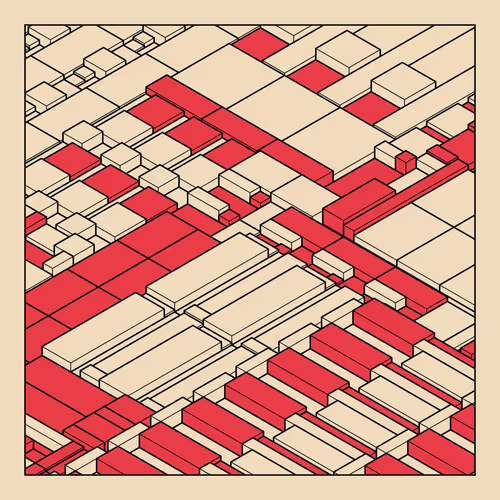
Archetype explores the use of repetition as a counterweight to unruly, random structures. As each single component look chaotic alone, the repetition brings along a sense of intentionality, ultimately resulting in a complex, yet satisfying expression.
Project description, Art Blocks — quoted as published, grammar included

He held that the system was the work, not the picture — in October 2020, ten months before long-form generative art had a name and an essay. Archetype ran in the same Art Blocks curated series as Ringers; its market profile stayed smaller than either of them, its position in the argument did not.
I think I kind of owe it to the world since my own progression has been so dependent on the generosity of others, so I feel like it's only natural that I open source my work. It leads to some weird cases where what I sell to people is actually open-source. Not even just to download for free, but to actually generate the work themselves, to generate however many examples they would like.
Artnome, interview with Jason Bailey, 11 October 2020Getting the actual token is kind of like my signature on the work and it would be a completely different thing if you just downloaded it for free.
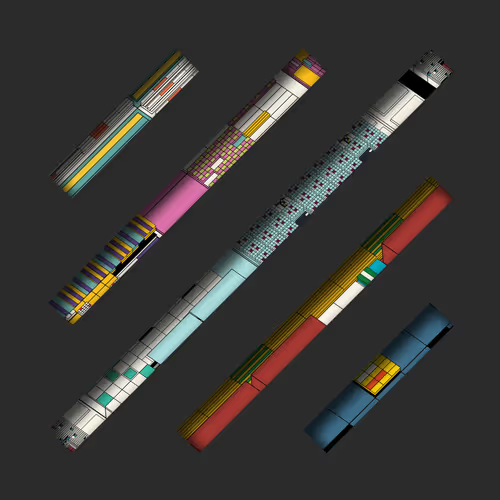
Artnome, interview with Jason Bailey, 11 October 2020Six iterations from Archetype, by Kjetil Golid, 2021. This long-form project set an incredibly high bar for consistent quality.
Tyler Hobbs, “The Rise of Long-Form Generative Art”, 6 August 2021 — on ArchetypeEvery figure above comes from Alfred’s own dataset — sales, volume and owners read off the chain, floors from the marketplaces. On a wallet he goes one step further, to the number that gets buried under a decade of transfers: what you actually paid.
In the wallets we look at, nearly half of what people hold has no purchase price to look up. It arrived as a mint, a swap or a transfer.
Alfred follows each one back through the chain.
Both figures come from one reading: 16 wallets, 3,548 items, Sep 2026.
See what your collection cost you