“Collective memories, archives, light, architecture, generative AI algorithms, software, hardware, code, sound, and, more recently, scent.”
— Refik Anadol, asked what he considers the materials of his art · MoMA Magazine, December 2022
I am trying to find ways to connect memories with the future, and to make the invisible visible.
— MoMA, “Unsupervised”, 2022
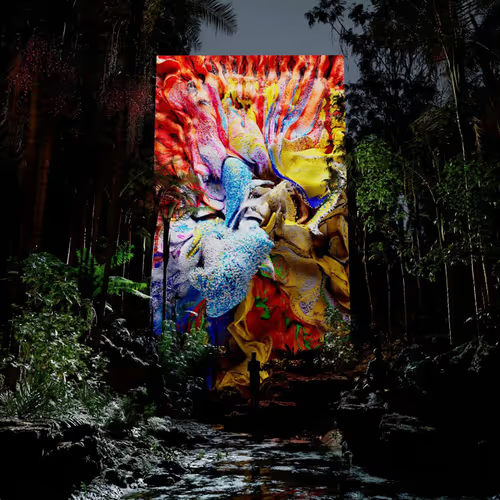
Anadol trained a sophisticated machine-learning model to interpret the publicly available data of MoMA's collection. As the model 'walks' through its conception of this vast range of works, it reimagines the history of modern art and dreams about what might have been—and what might be to come.
Curatorial text, MoMA
A first-of-its-kind space of co-creation between the Brazilian Indigenous Yawanawa community and media artist Refik Anadol.
Collection description, OpenSea
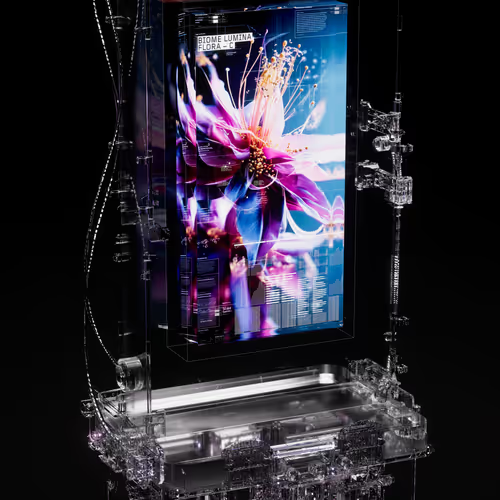
The Dataland Founding Digital Collection, Biome Lumina, is the first series of 1,000 unique living paintings on blockchain by Refik Anadol Studio for Dataland.
Collection description, OpenSea
1000 Unique AI Data Paintings created by 113 million images of New York City.
Collection description, OpenSeaHe works with the material nobody thinks of as material: archives, weather records, a museum's own catalogue. The machine is not the subject and not the author — it is the instrument through which a collective memory becomes something you can stand in front of.
We imagine a future where a symbiotic relationship with machines will give us new insights, knowledge, and the power to not only challenge but change existing systems.
MoMA Magazine, December 2022My work as a generative artist draws inspiration from the legacies of abstraction, systems art, Surrealism, and Expressionism.
MoMA Magazine, December 2022I completed my second master's degree at UCLA under the mentorship of Casey Reas, Christian Moeller, and Jennifer Steinkamp.
MoMA Magazine, December 2022Every figure above comes from Alfred’s own dataset — sales, volume and owners read off the chain, floors from the marketplaces. On a wallet he goes one step further, to the number that gets buried under a decade of transfers: what you actually paid.
In the wallets we look at, nearly half of what people hold has no purchase price to look up. It arrived as a mint, a swap or a transfer.
Alfred follows each one back through the chain.
Both figures come from one reading: 16 wallets, 3,548 items, Sep 2026.
See what your collection cost you